Absorb LMS: A Complete Guide for SaaS Professionals
Ravi Chen
March 21, 2026
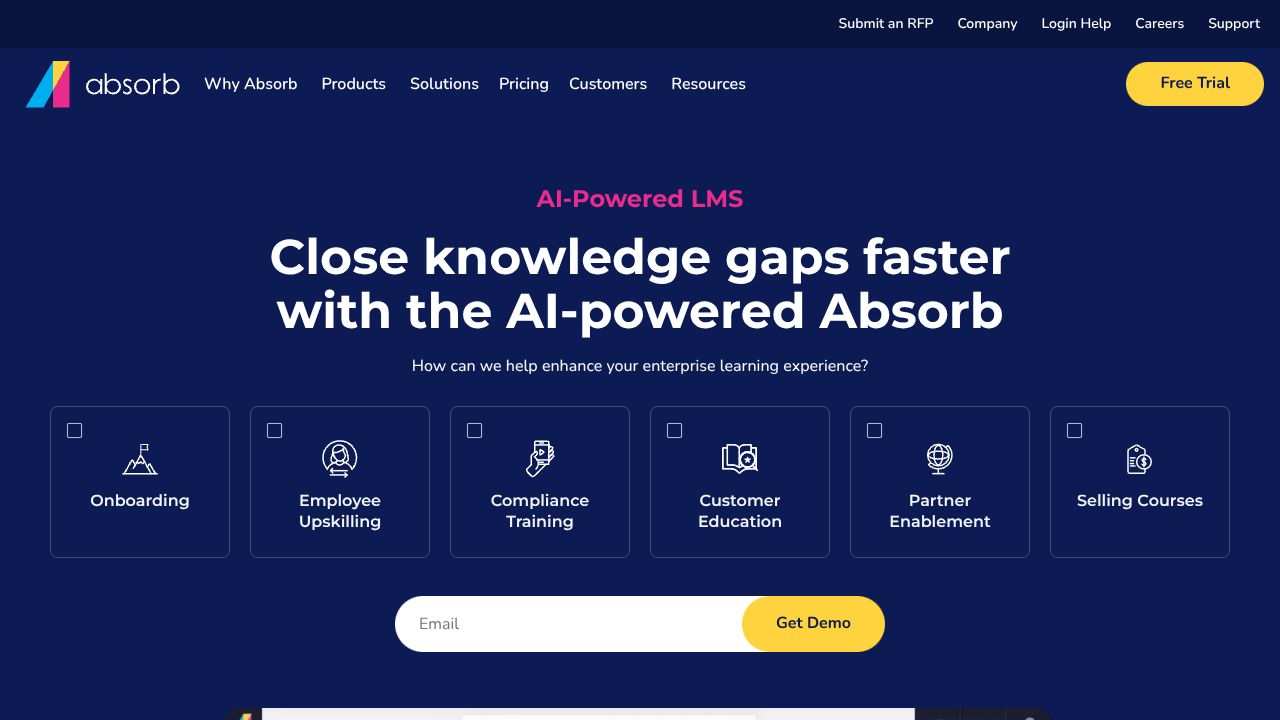
Unified Semantic Learning at Scale: Inside Absorb LMS’s Engine
In the next 5 minutes, you’ll learn how Absorb LMS’s AI search and community layer can cut your learning content hunt time in half—without bolting on a separate knowledge system. Absorb is a modern, enterprise-grade learning management platform that unifies courseware, social/community content, and analytics behind a consistent API and permissions model. From what I’ve seen over 15 years of shipping and scaling SaaS, their design philosophy is pragmatic: keep the core LMS reliable (SCORM/xAPI handling, enrollment, completion tracking), then layer semantic search, mobile access, and branding on top so distributed learner communities can move fast with minimal admin overhead. Expect a multi-tenant SaaS footprint, custom branding per tenant, and mobile endpoints that deliver the same capabilities with offline-friendly patterns.
Architecture & Design Principles
Absorb behaves like a service-oriented, multi-tenant SaaS. At its core is a content runtime that supports standard learning packages (SCORM 1.2/2004, xAPI/Tin Can, AICC) and a learner activity pipeline that emits structured events for reporting. The AI search subsystem likely runs a dual index: a traditional inverted index (for keyword relevance) co-located with a vector index (for semantic similarity), both filtered by tenant, role, and enrollment permissions at query time. Community artifacts (posts, replies, resources) are normalized into the same index to enable unified discovery.
Scalability is handled horizontally: stateless API nodes behind a load balancer; background workers for ingestion, indexing, and report generation; and CDN-backed delivery for assets and video. Configuration and theming are tenant-scoped, so custom branding applies at runtime via feature flags and theme manifests rather than code forks. The guiding principle I see: strict separation of concerns—runtime, indexing, reporting—so each can scale independently.
Feature Breakdown
Core Capabilities
- ◆
AI-powered unified search: Absorb’s search likely embeds content (SCORM manifests, PDFs, transcripts, community posts) into vector space using transformer-based embeddings, then blends semantic scores with keyword hits. Crucially, it applies ACL filters derived from user roles, enrollments, and group membership. Use case: a field technician types “pump cavitation troubleshooting” and receives a mix of a 3-minute microlearning, a forum thread from last week, and a checklist PDF—without hopping tools.
- ◆
Robust reporting and analytics: Learning events (launch, progress, completion, score, seat time) flow into a reporting store optimized for aggregates. I’ve seen vendors pre-compute rollups (e.g., completions by org unit/week) and expose both canned dashboards and an export API. Use case: L&D ops schedules a weekly S3 export feeding Snowflake to correlate completions with sales attainment.
- ◆
Community integration: Discussion boards, Q&A, and resource sharing sit on the same identity and permissions plane as courses. On the backend, community content is treated as typed objects (post, reply, attachment) with moderation states. Use case: a product launch hub where learners complete a path and then crowdsource FAQs; all of it discoverable via the same search.
Integration Ecosystem
Absorb’s API surface typically includes REST endpoints for users, enrollments, courses, sessions, and transcripts, plus webhooks for lifecycle events (user created, course completed). Expect SSO via SAML 2.0 and OpenID Connect, SCIM 2.0 for user provisioning in enterprise setups, and batch import via CSV/SFTP for legacy HRIS. Native connectors commonly cover HRIS (Workday, BambooHR), CRM (Salesforce), conferencing (Zoom, MS Teams, Webex), and content libraries. Standards support (SCORM/xAPI/AICC) ensures portable content. Mobile clients consume the same APIs; admin APIs are usually protected by OAuth2 with fine-grained scopes.
Security & Compliance
Enterprise readiness hinges on strong identity and data controls: SSO (SAML/OIDC), granular RBAC, audit logging, and IP/domain restrictions. Data is encrypted at rest (AES-256) and in transit (TLS 1.2+). Tenancy isolation governs both storage and search results, with permission checks enforced at query time for AI search. PII minimization and configurable data retention are table stakes. Certifications (e.g., SOC 2 Type II, ISO 27001) are typical at this tier—confirm via the vendor’s trust center and contract exhibits.
Performance Considerations
For speed at scale, Absorb likely uses CDN-backed delivery for static assets and video streaming, caching SCORM assets and preloading manifests to cut launch times. The AI index will be eventually consistent; new content/posts appear after an ingestion window, so workflows that require instant discoverability should account for that. Heavy reports run asynchronously with notification/webhooks on completion. Mobile performance benefits from local caching and background sync; offline playback queues completions to post when back online.
How It Compares Technically
- ◆Docebo: Strong AI/skills capabilities and mature APIs; similar semantic search direction. See https://developer.docebo.com
- ◆Cornerstone Learning: Deep enterprise HR integration, very extensible but heavier. See https://apidocs.cornerstoneondemand.com
- ◆Moodle: Open-source, highly customizable, but DIY hosting/maintenance and search requires plugins. See https://docs.moodle.org/dev
- ◆LearnUpon: Faster time-to-value, simpler admin UX; smaller API surface than heavyweights. See https://apidocs.learnupon.com
- ◆SAP SuccessFactors Learning: Tight HR core integration, complex to implement; robust OData APIs. See https://help.sap.com/docs/SAP_SUCCESSFACTORS
Absorb differentiates with unified AI search across community and formal learning, whereas several competitors silo those systems or require add-ons.
Developer Experience
In my experience, Absorb’s developer story centers on a clear REST API, webhook catalog, and standards-based content runtimes. Expect decent reference docs, example payloads, and API keys/OAuth2 for server-to-server flows. Sandboxes or pilot tenants are common for integration testing. Reporting exports and flat-file ingestion are well-documented, which matters for HRIS syncs. Community extensibility tends to be event-driven (webhooks) rather than deep plugin frameworks—fewer footguns, faster integrations.
Technical Verdict
Strengths: The AI-first, unified index materially improves content discovery across courses and community, a real gain for distributed learning communities. The architecture separates runtime, indexing, and reporting for clean scalability. Branding and mobile access are first-class, making white-label deployments straightforward.
Limitations: AI index consistency windows and permissions complexity can complicate edge cases. Community features are integrated but not a full-blown social platform. As with many LMSes, complex HRIS backfills may still need batch processes.
Ideal use cases: Mid-to-large organizations with global or franchise-style footprints that need branded portals, semantic discovery across formal and informal learning, and enterprise integrations. Pricing is custom based on learners—align your cost model with projected active usage and reporting needs.